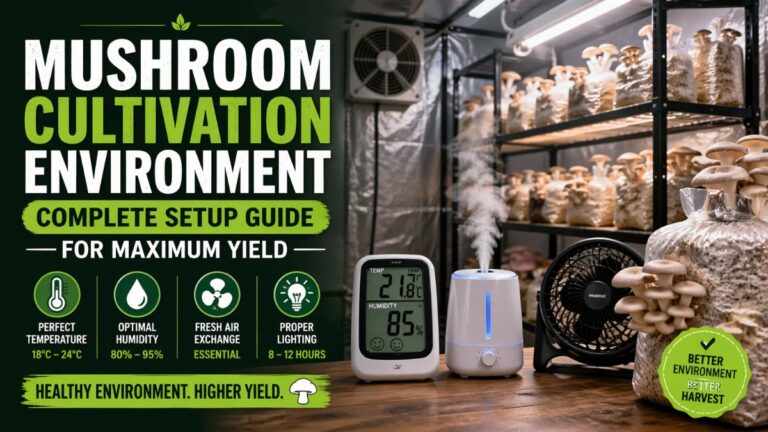

You did everything right. The substrate was clean, colonization was fast, and the humidity was dialed in. Then the pins appeared, and the mushrooms came out with long, skinny stems and tiny caps. Or the pins just stalled and never grew.
Before you blame your spawn or your substrate, look at the air. This Mushroom FAE Guide explains what fresh air exchange is, why mushrooms react to it so strongly, and how to spot a problem early. You’ll also learn how to fix it in a tub, a tent, or a full grow room. Once you get airflow right, flushes tend to arrive faster, look better, and weigh more.
What Is Fresh Air Exchange and Why Do Mushrooms Care?
Fresh air exchange, or FAE, simply means replacing the stale air in your growing space with fresh air from outside. It sounds minor, but it’s one of the biggest levers you have once fruiting begins.
Mushrooms breathe like we do
Mushrooms take in oxygen and release carbon dioxide (CO₂). During colonization, mycelium is quietly working inside a sealed bag or jar, and high CO₂ is actually fine there. It even encourages the mycelium to spread.
Fruiting is different. Growing mushrooms are metabolically active, and they produce a lot of CO₂ in a short time.
Why CO₂ builds up so fast
In a closed tub, tent, or room, that CO₂ has nowhere to go. It’s heavier than the surrounding air and tends to pool around your mushrooms, right where the pins are trying to form.
Mushrooms read high CO₂ as a signal: “I’m still underground or in a crowded, sheltered spot.” So they stretch their stems and hold back their caps, searching for open air. Fresh air tells them it’s safe to open up and spread.
Signs Your Mushrooms Aren’t Getting Enough Fresh Air
Your crop will usually tell you when the air is off. The trick is learning to read the signals before you lose a whole flush.
Visual warning signs of poor air exchange
If you want to know the signs of poor fresh air exchange in mushrooms, check for these first:
- Long, leggy stems with small, underdeveloped caps
- Coral-like or antler-shaped growth. This is especially common with lion’s mane and reishi.
- Pins that stall and never develop into full mushrooms
- Clustered, twisted, or deformed fruits
- Slow, uneven pinning across the substrate surface
- A sour, stale smell inside the chamber
Lion’s mane is the best warning light in your setup. It reacts quickly, and if yours looks more like icicles or branching coral than a neat pom-pom, your air is almost certainly stale.
Too much air causes problems too
More isn’t always better. Overdoing FAE strips moisture from your pins and the substrate surface. Watch for:
- Dry, cracked caps
- Pins that darken, shrivel, or abort
- A substrate surface that dries out within hours
- Humidity that never climbs back up, no matter how much you mist
Fresh air and humidity pull against each other. The goal isn’t maximum airflow. It’s enough air to keep CO₂ down while keeping humidity high.
How Much Fresh Air Do Mushrooms Need?
This is the question every grower asks, and the honest answer is that it depends. Still, there are solid starting points.
Needs change by growth stage
- Incubation or colonization: Very little. Sealed bags and jars are fine, and higher CO₂ is not a problem here.
- Pinning (the trigger stage): This is where fresh air matters most. Most growers aim to bring CO₂ down sharply, often below about 1,000 ppm, to encourage strong pin formation.
- Fruiting (pins growing into mushrooms): Keep air moving steadily. Fast-growing mushrooms produce the most CO₂ during this stage, so airflow needs often rise as the fruits get bigger.
Species differences
Not every mushroom is equally demanding.
- Oyster mushrooms are fast and hungry for air. They need frequent exchange and punish stale conditions quickly.
- Lion’s mane is very sensitive. Even moderate CO₂ buildup changes how it grows.
- Shiitake is generally more forgiving, though it still does better with steady fresh air during fruiting.
- Button-type mushrooms are often grown with somewhat different CO₂ targets, so check guidance for your specific variety.
If you’re unsure, start with oyster-level airflow as a baseline, then adjust based on what your mushrooms actually look like.
A Practical Mushroom FAE Guide for Every Setup
The right method depends on how much space you’re managing. Here’s how to handle the most common setups.
Monotubs and shotgun fruiting chambers
Small chambers rely on passive air exchange. That usually means holes drilled around the container, or a “shotgun” pattern of small holes in a clear tub.
- Use evenly spaced holes so air can flow in and out naturally.
- Fan the tub with a lid or a clean towel a few times a day to push out stale air.
- Watch the pins. If they get leggy, add more holes or fan more often.
This setup is cheap and beginner-friendly, but it gives you the least control. It works best for one or two tubs.
Grow tents
Tents need active airflow. Most growers use a small inline fan on a speed controller or timer, plus a filtered passive intake on the opposite side.
- Place the exhaust fan high, since warm, CO₂-rich air rises and pools near the top.
- Put the fresh air intake low, on the opposite side.
- Run the fan on a timer. A few minutes every half hour is a common starting point, adjusted by what you see.
Larger grow rooms
Bigger rooms need real calculations. You’ll want properly sized fans, ducting, and filtered intakes, and ideally a CO₂ monitor. At this scale, guessing gets expensive because one bad week of airflow can cost you an entire flush across dozens of blocks.
Mushroom Grow Room Ventilation Tips That Actually Work
Good ventilation is more than a fan on a wall. These mushroom grow room ventilation tips apply whether you’re running one tent or twenty blocks.
Balance airflow and humidity
Fresh air is usually dry, so you’ll often need to pair your fans with a humidifier.
- Run your humidifier on a controller so it responds when humidity drops.
- Use fans in short bursts instead of constant blasts.
- Mist the walls, not the pins. Water sitting directly on tiny pins can cause bacterial blotch.
Filter and direct the air
- Filter your intake. A simple pre-filter keeps dust, spores, and mold contaminants out of your grow space.
- Avoid blowing directly on pins. A steady stream of air dries them out fast. Aim for gentle, indirect circulation.
- Keep it clean. Dusty fan blades and dirty filters spread contaminants and lower airflow.
- Seal the gaps. Uncontrolled leaks undermine your whole system, because air will take the easiest path rather than the one you planned.
How to Increase Fresh Air Exchange for Mushrooms
If you suspect your air is stale, here’s how to increase fresh air exchange for mushrooms without wrecking your humidity.
Start small and watch
Change one thing at a time, then wait a day or two before judging the result.
- Add a few more holes or fan more often.
- Run your exhaust fan a little longer each hour.
- Slightly increase humidifier output if the air gets dry.
- Look at the next set of pins and compare them with the previous ones.
Mushrooms grow quickly, so you’ll see results within a day or two. Thicker stems, flatter caps, and more even pinning are all good signs.
Use a CO₂ meter if you can
A basic CO₂ meter takes the guesswork out of everything. It shows you exactly what’s happening inside your chamber, and many growers say it’s the best small purchase they’ve made.
Keep in mind that cheap meters can drift, so treat them as a guide rather than gospel. Your mushrooms’ appearance is still the final judge.
Calculate Your Airflow Instead of Guessing
If you’re running a tent or a dedicated room, a little math removes a lot of trial and error.
The simple formula
- Multiply length × width × height to get your room volume in cubic feet.
- Decide how many air changes per hour (ACH) you want.
- Multiply volume by ACH, then divide by 60 to get the airflow you need in CFM (cubic feet per minute).
Example: A 10 × 10 × 8 ft room holds 800 cubic feet. At 6 air changes per hour, you’d need 800 × 6 ÷ 60 = 80 CFM.
Growers often start with several air changes per hour for fruiting rooms, and fast, air-hungry species like oysters may call for more. Treat the number as a starting point, then adjust based on how your mushrooms respond.
Let a calculator do the work
If you’d rather skip the math, our Mushroom FAE (Fresh Air Exchange) Calculator works out the airflow your space needs in seconds. Enter your room dimensions, and it helps you choose a fan size so you aren’t over- or under-ventilating.
Common FAE Mistakes to Avoid
Even experienced growers slip up. Watch out for these:
- Fanning only after problems appear. Prevention beats rescue.
- Treating all species the same. Oysters and lion’s mane have very different tolerances.
- Ignoring humidity while adding airflow. More air without more moisture dries your pins.
- Skipping filters. Fresh air that carries contamination is worse than stale air.
- Changing everything at once. You’ll never know which change actually helped.
FAQs
How often should I fan my monotub?
Most growers fan two to four times a day during pinning and fruiting, adjusting based on how the pins look. If stems get long and thin, fan more often. If the surface dries out, fan less or add moisture.
Can mushrooms get too much fresh air?
Yes. Too much airflow dries out pins and caps, causes cracking, and can make pins abort. The goal is steady, gentle airflow that keeps CO₂ low without dropping your humidity.
Do I need FAE during colonization?
Usually not. Mycelium tolerates and even prefers higher CO₂ during colonization, so sealed bags and jars are fine. Fresh air becomes important once you move into pinning and fruiting.
What’s the easiest way to know if my FAE is right?
Look at your mushrooms. Thick, sturdy stems and well-formed caps usually mean your airflow is on track. Leggy stems, coral shapes, or stalled pins point to stale air.
Conclusion
Fresh air exchange isn’t a fancy technique. It’s one of the simplest, cheapest ways to improve your harvests. The quality of your next flush can come down to how well you manage the air around your mushrooms.