You’ve babysat your substrate for weeks. The jar or bag is finally wrapped in healthy white mycelium, and everything looks textbook perfect. So why is nothing happening? No tiny bumps, no baby mushrooms, just a stubborn block of white that refuses to do anything. If that sounds familiar, you’re not alone, and understanding the Mushroom Pinning Trigger is exactly what you need to get unstuck. In this guide, you’ll learn what flips the switch from colonization to fruiting, why mushrooms stall, and the practical steps to initiate fruiting reliably.
Pinning is the make-or-break stage. Nail the triggers, and the rest of your grow mostly takes care of itself. Miss them, and you’ll stare at a fully colonized substrate for days wondering what went wrong.
What Does “Pinning” Actually Mean?
Before you can trigger it, it helps to know what you’re triggering.
Pinning is the moment mycelium shifts from spreading outward (vegetative growth) to building reproductive structures. Those little white bumps, called “pins” or primordia, are baby mushrooms. Left alone in the right conditions, they’ll swell into full fruit within days.
Colonization vs. Fruiting
These are two completely different survival modes for the fungus:
- Colonization: The mycelium eats, expands, and claims territory. It prefers to stay hidden, warm, and undisturbed.
- Fruiting: The mycelium decides it’s time to reproduce and spread spores. This only happens when it senses the environment has changed in a way that signals opportunity.
The whole art of initiating fruiting is convincing your mushrooms that the “good times” of easy eating are ending and it’s time to make spores before conditions get tough.
Why Pins Matter So Much
Pins are your first visible proof that fruiting has begun. More pins generally means a bigger, more even flush. Uneven or sparse pinning usually traces back to one or more triggers being off, which is why this stage deserves your full attention.
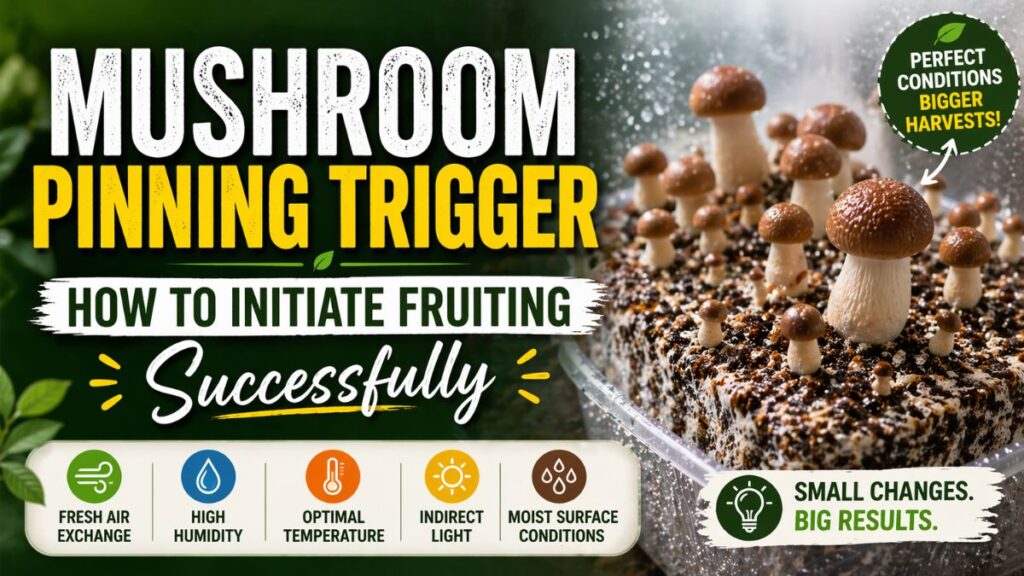
The Core Mushroom Pinning Trigger: Initiate Fruiting the Right Way
Here’s the central idea: mycelium doesn’t fruit on a timer. It fruits in response to environmental signals. Change the signals, and you change its behavior.
There are four main levers you can pull, and most successful grows use them together rather than one at a time.
1. Fresh Air Exchange (Dropping CO2)
During colonization, mycelium is happy in high carbon dioxide. Fruiting is the opposite.
- High CO2 tells the fungus it’s still buried and safe underground.
- A sudden drop in CO2 mimics the surface, where spores can actually travel on air currents.
Introducing fresh air, by fanning, cracking a lid, or running passive air holes, is one of the strongest signals you can send. If your mushrooms refuse to pin, stale air is the usual suspect.
2. A Temperature Drop
In nature, many mushrooms fruit after a cool snap, mimicking the shift from summer into autumn.
- A drop of a few degrees from your colonization temperature often kickstarts primordia formation.
- You don’t need anything dramatic. Moving a tub from a warm closet to a cooler room frequently does the trick.
Not every species needs a cold shock, but most beginner-friendly varieties respond well to even a modest dip.
3. Light Exposure
Mushrooms don’t use light for food, but they do use it as a compass.
- Indirect light signals the fungus where “up” is and where open air exists.
- A normal room-light cycle, or a few hours of ambient daylight, is plenty. Direct sun is unnecessary and can dry things out.
Think of light as a nudge, not a requirement in large doses. Twelve hours of soft, indirect light daily is a common, reliable target.
4. High Humidity and Surface Moisture
Even with perfect air, temperature, and light, dry pins simply abort. Moisture holds everything together.
- Fruiting conditions usually call for very high relative humidity, often in the 90% range early on.
- The surface of the substrate needs to stay damp enough that forming pins don’t dry out and die.
This is where many growers overcorrect in one direction, either drowning their substrate or letting it crust over. Balance is everything.
How to Trigger Mushroom Pinning in a Monotub (Step by Step)
If you grow in a monotub or similar container, here’s a clean, repeatable sequence to initiate fruiting once colonization is complete.
Step 1: Confirm Full Colonization
Don’t rush. Patchy white with uncolonized spots will often contaminate once you introduce air.
- Wait for the substrate to look fully, evenly white.
- Give it a few extra days of “consolidation” if you’re unsure. Mature mycelium pins far better than young mycelium.
Step 2: Introduce the Trigger Combo
Now change several signals at once:
- Open up fresh air exchange.
- Lower the temperature slightly.
- Begin a light cycle.
- Keep humidity high with misting or a humid environment.
Changing these together sends a loud, unmistakable “time to fruit” message.
Step 3: Maintain, Don’t Fiddle
This is where patience pays off.
- Keep conditions stable for several days.
- Resist the urge to open the tub constantly, which dries the surface and stresses forming pins.
- Watch for tiny droplets and white bumps, your first signs of success.
Dialing in these exact conditions by guesswork can be frustrating, which is why many growers use a Mushroom Pinning Trigger Calculator to estimate ideal fresh air, temperature, and humidity targets for their setup before they ever open the lid.
Why Won’t My Mushrooms Pin? Common Problems and Fixes
If you’ve done everything “right” and still see nothing, one of these issues is almost always the culprit.
Too Much CO2
The most frequent reason for stalled fruiting.
- Symptom: Flat, featureless white surface, sometimes with fuzzy aerial growth reaching upward.
- Fix: Increase fresh air exchange immediately. More fanning, more air holes, or a cracked lid.
Surface Too Dry
Pins can’t form on a crusty, dried-out top layer.
- Symptom: Dry, cracked-looking surface, or pins that start then shrivel.
- Fix: Raise humidity and lightly mist. Avoid soaking, which causes its own problems.
Not Enough Air Means Leggy Growth
When you get air flow and CO2 balance wrong, you often see stems stretch oddly.
- Symptom: Long, thin stems with tiny caps.
- Fix: More fresh air almost always corrects this. Leggy growth is the fungus reaching for oxygen.
Impatience
Sometimes nothing is wrong at all.
- Some strains take longer to pin than others.
- Give a fully colonized, properly triggered substrate at least several days before assuming failure.
Fruiting Conditions for Mushroom Pinning: Quick Reference
Keep these general targets in mind as a starting framework. Fine-tune for your specific species.
- Fresh air: Frequent exchange; low CO2 at the surface.
- Temperature: A few degrees below colonization temperature.
- Humidity: Very high, often around 90% in early pinning.
- Light: Indirect, roughly 12 hours a day.
- Patience: Stable conditions held consistently, not constantly adjusted.
Reading Your Mushrooms
Your substrate will tell you what it needs if you learn to read it:
- Fuzzy upward growth = too much CO2, needs air.
- Dry or cracked surface = needs humidity.
- Pins appearing then dying = usually moisture or air instability.
- Even, healthy pins = you nailed the mushroom pinning temperature and humidity balance.
Putting It All Together
Successful fruiting isn’t about one magic trick. It’s about sending several honest environmental signals at once so the fungus confidently decides to reproduce.
The winning pattern looks like this:
- Let colonization finish fully.
- Drop CO2 with fresh air.
- Cool things down slightly.
- Add gentle light.
- Lock in high humidity.
- Then wait, and resist the urge to interfere.
Do that consistently, and pinning stops feeling like luck and starts feeling like a process you control.
FAQs
How long after colonization should pins appear?
Usually within several days to about two weeks after you introduce fruiting triggers, depending on the species and strain. A fully colonized substrate that has consolidated for a few extra days tends to pin faster and more evenly.
Do I need a cold shock to initiate fruiting?
Not always. Many popular, beginner-friendly varieties pin well with just a modest temperature drop and good fresh air. A dramatic cold shock is optional and species-dependent, not a universal requirement.
Why are my pins turning brown or aborting?
Aborts almost always come from unstable conditions, especially a surface drying out or wild swings in air flow and humidity. Keep moisture high and conditions steady, and open the container less often.
Can too much fresh air hurt pinning?
Yes. While low CO2 triggers fruiting, excessive air flow dries the surface and can kill forming pins. The goal is a balance: enough fresh air to signal “surface,” without stripping away the moisture pins need to grow.
Final Thoughts
Pinning is the stage where impatient growers quit and informed growers succeed. Now that you understand the real mushroom pinning trigger (fresh air, a temperature drop, light, and humidity working together), you can coax those first mushrooms out reliably instead of hoping and guessing.