You nailed it with a few trays. The flushes were thick, the caps were firm, and contamination stayed away. So you decided to grow more — maybe double, maybe ten times the volume — and suddenly things got messy. Spotty colonization, slower pins, the odd bag going green. If that sounds familiar, you’re running into the exact wall that Mushroom Batch Scaling is meant to solve. Growing more mushrooms isn’t just “do the same thing, but bigger.” It’s a shift in how you manage substrate, airflow, sterility, and timing all at once.
This article breaks down how to scale your grow the right way: what actually changes when batch sizes climb, where quality tends to slip, and the practical moves that keep your yields clean and consistent. Whether you’re a hobbyist outgrowing a closet or a small farm eyeing wholesale orders, these principles apply.
Why Batch Scaling Is Harder Than It Looks
Small grows forgive mistakes. A tiny tub holds humidity on its own, a single jar colonizes fast, and your eyes can spot trouble early. Scale up, and those built-in safety nets disappear.
The core issue is that mushrooms are living organisms reacting to their environment in real time. When you multiply the biomass in a room, you multiply the demand on that room too — more CO₂ exhaled, more moisture released, more heat generated by colonizing mycelium.
The Hidden Variables That Multiply
A few things grow faster than your mushroom count when you scale:
- Heat load — Colonizing substrate is metabolically active and releases warmth. Ten blocks together can run several degrees hotter than one.
- Humidity swings — More fruiting surface pulls moisture from the air faster, drying out your room unless you adjust misting or humidification.
- Contamination exposure — Every extra bag, jar, or tray is another chance for mold or bacteria to sneak in.
- Airflow dead zones — In a packed fruiting chamber, some corners get fresh air and others suffocate in stale CO₂.
Recognizing that these scale non-linearly is the first real step in learning how to scale mushroom production without the usual headaches.
Planning Your Substrate the Smart Way
Substrate is where most scaling problems start — and where they’re easiest to prevent. When you prepare one bag, eyeballing water content works fine. At volume, small errors in hydration or nutrition get amplified across every single unit.
Keep Your Recipe Consistent
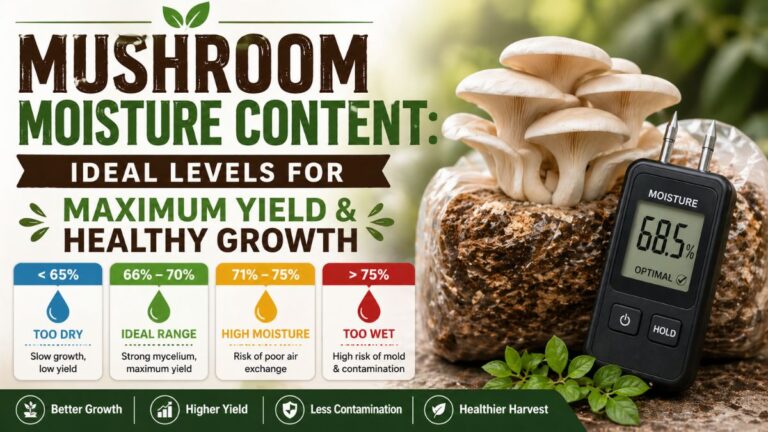
Lock in a repeatable substrate recipe before you scale. Write down exact ratios by weight, not by scoop or feel. Grain-to-sawdust ratios, supplementation percentages, and field capacity moisture should be identical from batch to batch. Consistency here is what lets you compare results and actually learn from them.
Match Substrate Volume to Your Space
Overpacking a room is a classic beginner trap. Each block needs breathing room for gas exchange and even fruiting. Before you commit, work out how much substrate your space can genuinely support rather than cramming in as much as physically fits. Good mushroom batch size planning means leaving deliberate gaps between blocks so air moves freely and every fruiting surface gets what it needs.
A quick way to crunch these numbers is to use the Mushroom Batch Scaling Calculator, which helps you translate a small successful grow into a larger one without guesswork on substrate weight, spawn ratios, and container counts.
Sterility at Scale: Your Make-or-Break Factor
Here’s the honest truth: contamination is the number one reason scaled grows fail. At small volumes you might lose one jar and shrug. At larger volumes, a single sterility slip can wipe out an entire run and the weeks of work behind it.
Upgrade Your Process, Not Just Your Equipment
Many growers assume scaling means buying a bigger pressure cooker or a flow hood — and those help. But the bigger win is tightening your workflow:
- Sterilize or pasteurize in full, consistent loads so every unit gets the same treatment time and temperature.
- Inoculate in a clean, still-air space with minimal foot traffic and no open windows.
- Handle grain spawn quickly and in smaller working batches so nothing sits exposed.
- Label everything with dates so you can trace exactly where a problem entered.
Learning to avoid contamination when scaling mushrooms is less about fancy gear and more about disciplined, repeatable habits. The grower who does the boring things the same way every time beats the one with the expensive flow hood and sloppy technique.
Isolate Your Stages
As volume grows, keep your lab work, colonization, and fruiting in separate zones. Fruiting chambers are humid and full of spores — exactly the environment you don’t want near fresh inoculations. Physical separation between “clean” and “dirty” areas dramatically cuts cross-contamination.
Managing the Fruiting Environment
Colonization is only half the battle. Fruiting at scale is where quality visibly rises or falls — in cap size, density, color, and shelf life.
Airflow Is Everything
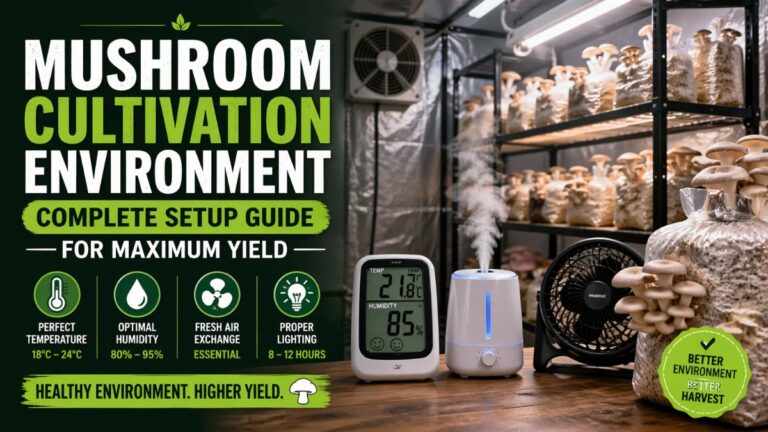
Mushrooms “breathe out” CO₂, and in a crowded chamber that gas pools fast. Too much CO₂ gives you long, stringy stems and small caps. The fix is steady fresh-air exchange combined with gentle circulation so no corner stagnates. As you scale, you’ll likely need active ventilation — small fans on timers, or an inline fan pulling fresh air — rather than relying on opening a lid by hand.
Humidity and Misting Discipline
Bigger rooms dry unevenly. Aim for consistent high humidity without soaking your mushrooms, which invites bacterial blotch and reduces shelf life. An ultrasonic humidifier on a controller beats manual misting once you pass a certain size, because it responds to the room instead of your memory.
Light and Timing Cues
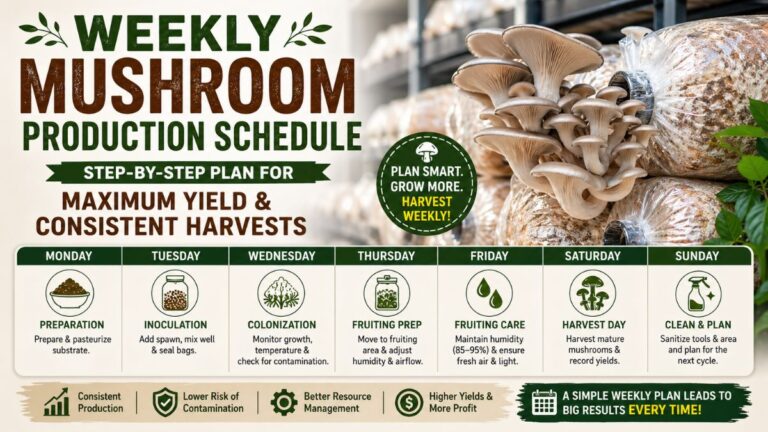
Mushrooms don’t need much light, but they do need some, and it should reach every block evenly. Stagger your inoculations so batches fruit on a predictable schedule rather than all at once — this smooths out your harvest workload and keeps you from being overwhelmed during peak flushes.
Harvesting and Quality Control
Growing more means harvesting more, and rushed harvesting is where quality quietly erodes.
Harvest at the Right Moment
Pick just before or as caps begin to open, depending on your species and market. Waiting too long drops spores everywhere (a contamination and air-quality issue at scale) and leaves you with lower-grade product. Train anyone helping you to recognize the same harvest window so your batches stay uniform.
Build a Simple Grading Habit
As output rises, sort your mushrooms into grades — premium, standard, and processing — right at harvest. This keeps your best product looking its best and gives you a clear read on whether quality is holding steady as you scale. Maintaining mushroom quality when growing more depends on catching slippage early, and grading is your built-in checkpoint.
Scaling in Steps, Not Leaps
The safest path to higher volume is incremental. Doubling is manageable; jumping tenfold overnight rarely ends well.
The Double-and-Verify Approach
Increase your batch size in stages. Run the larger batch, record your results, and confirm your yields and contamination rates hold before scaling again. Each successful step gives you the data and confidence to take the next one. This patient rhythm is the difference between a grow that stays healthy and one that collapses under its own ambition.
Track Your Numbers
Keep a simple log for every batch: substrate weight, spawn ratio, colonization time, yield, and contamination count. Over a few cycles, patterns emerge — maybe a certain supplementation level yields more, or a particular room spot runs hot. These records turn guesswork into a system you can trust and repeat.
Frequently Asked Questions
How much can I scale my mushroom grow at once?
A good rule is to roughly double your batch size per step rather than making huge jumps. Verify that your yield and contamination rates stay stable before scaling again, so problems stay small and traceable.
Why do my mushrooms get smaller when I grow more?
Usually it’s CO₂ buildup and uneven airflow in a crowded chamber. More fruiting biomass releases more CO₂, so you’ll need stronger fresh-air exchange and circulation to keep caps full and stems short.
Does scaling always increase contamination risk?
It raises exposure, but it doesn’t have to raise your failure rate. Disciplined sterile technique, separated grow zones, and consistent sterilization loads keep contamination low even at higher volumes.
What’s the easiest way to calculate larger batch sizes?
Use a dedicated tool like the Mushroom Batch Scaling Calculator to convert a small successful grow into accurate substrate, spawn, and container numbers for a bigger run, instead of estimating by hand.
Final Thoughts
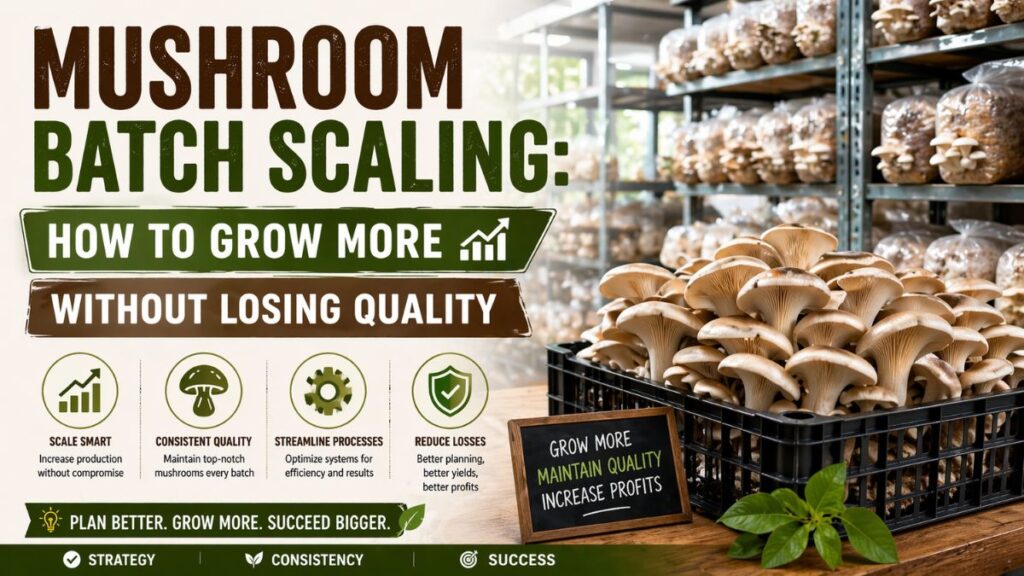
Scaling your mushroom operation is genuinely exciting — more harvests, more income, more of the hobby or business you love. But the growers who succeed aren’t the ones who rush. They’re the ones who treat Mushroom Batch Scaling as a disciplined process: consistent recipes, clean workflows, smart airflow, and careful step-by-step growth backed by real numbers.
Start with one change from this guide. Tighten your substrate consistency, upgrade your airflow, or log your next batch properly. Then scale in steady steps, learning as you go. Your mushrooms — and your bottom line — will thank you for it.