
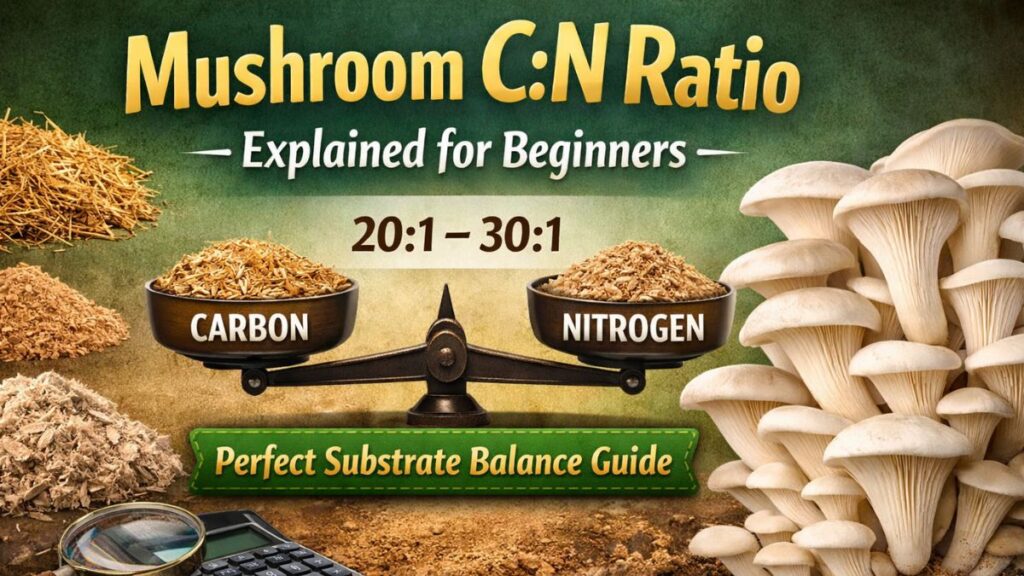
Have you ever wondered why some mushroom growers get thick, healthy flushes while others struggle with slow growth or contamination? The secret often lies in one overlooked factor—the carbon-to-nitrogen balance. In this Mushroom C:N Ratio Explained for Beginners guide, you’ll discover how mastering this simple concept can dramatically improve your yields, speed up colonization, and reduce costly mistakes.
Whether you’re growing mushrooms at home or planning a small farm, understanding the C:N ratio is like unlocking a hidden growth formula. Let’s break it down in a simple, practical way.
What Is Mushroom C:N Ratio and Why It Matters
Understanding Carbon and Nitrogen in Substrates
The C:N ratio refers to the balance between carbon (C) and nitrogen (N) in your growing substrate.
- Carbon = energy source (e.g., straw, sawdust)
- Nitrogen = protein-building nutrient (e.g., bran, manure)
Mushrooms rely on both, but the balance is critical.
Ideal C:N Ratio for Mushroom Growth
Most gourmet mushrooms thrive in a ratio between:
- 20:1 to 30:1
This means 20–30 parts carbon for every 1 part nitrogen.
Why the Right Balance Is Crucial
Getting the substrate carbon nitrogen balance for mushrooms right leads to:
- Faster mycelium growth
- Higher yields
- Reduced contamination risk
- Healthier fruiting bodies
Too much nitrogen? You risk contamination. Too much carbon? Growth slows down.
How to Calculate and Adjust Mushroom C:N Ratio
Step-by-Step Guide for Beginners
Follow this simple process to balance your substrate:
- Choose your base materials
- High carbon: straw, sawdust
- High nitrogen: wheat bran, soybean meal
- Estimate their C:N values
- Straw: ~80:1
- Sawdust: ~200:1
- Bran: ~15:1
- Mix to reach the ideal ratio
Combine high-carbon and high-nitrogen materials carefully. - Adjust moisture content
Proper hydration ensures nutrient absorption. - Test and refine
Observe growth and tweak ratios if needed.
👉 To make this process easier, use this helpful tool:
Mushroom C:N Ratio Calculator
https://mushroomcalculators.com/tool/mushroom-cn-ratio-calculator/
Best Substrate Mix Examples
Here are beginner-friendly combinations:
- Straw (80%) + Bran (20%)
- Sawdust (75%) + Soybean Meal (25%)
These mixes help achieve the best C:N ratio for mushroom substrate.
Pro Tips for Accuracy
- Use a digital scale for precision
- Start simple before experimenting
- Keep records of each batch
Tips, Benefits, and Common Mistakes to Avoid
Key Benefits of Proper C:N Ratio
Maintaining the right balance gives you:
- Stronger mycelium networks
- Faster colonization time
- Bigger and denser mushroom flushes
- Lower risk of contamination
Common Mistakes Beginners Make
Avoid these pitfalls:
- ❌ Adding too much nitrogen (leads to bacterial growth)
- ❌ Ignoring substrate moisture
- ❌ Not sterilizing or pasteurizing properly
- ❌ Using random ratios without calculation
Safety and Best Practices
To ensure safe and successful cultivation:
- Always sterilize or pasteurize substrates
- Work in a clean environment
- Store materials properly to prevent mold
- Wear gloves and maintain hygiene
Expert Advice for Better Results
- Stick to tested ratios before experimenting
- Monitor temperature and humidity along with C:N ratio
- Learn from each batch and refine your process
FAQs
1. What is the ideal C:N ratio for mushroom cultivation?
Most mushrooms grow best in a 20:1 to 30:1 ratio, depending on the species.
2. Can I grow mushrooms without calculating the C:N ratio?
Yes, but results may be inconsistent. Proper calculation ensures better yields and fewer failures.
3. What happens if the C:N ratio is too high or too low?
- Too high (more carbon): slow growth
- Too low (more nitrogen): contamination risk
Conclusion
Mastering the C:N ratio isn’t complicated—it just requires a bit of attention and practice. By following this Mushroom C:N Ratio Explained for Beginners guide, you can create the perfect substrate balance, boost your yields, and grow healthier mushrooms with confidence.