
You sterilized the bags, bought good spawn, and kept the room clean. Two weeks later, one bag is glowing white while its twin has barely started. Same recipe, same shelf, completely different result.
Often the hidden difference is the mushroom spawn ratio: how much spawn you mix into your substrate. Too little, and contaminants get a head start. Too much, and you spend extra money without growing a single extra mushroom.
In this guide, you’ll learn what the ratio really means, which numbers work for popular mushrooms, and how to work out your own in under a minute. Whether you grow oysters in a spare room or lion’s mane in a small tent, this one adjustment can reshape your harvest.
What Spawn Ratio Actually Means
The simple definition
Spawn is mushroom mycelium growing on a carrier, usually grain or sawdust. Substrate is the food you want that mycelium to colonize, such as straw, hardwood sawdust or coco coir.
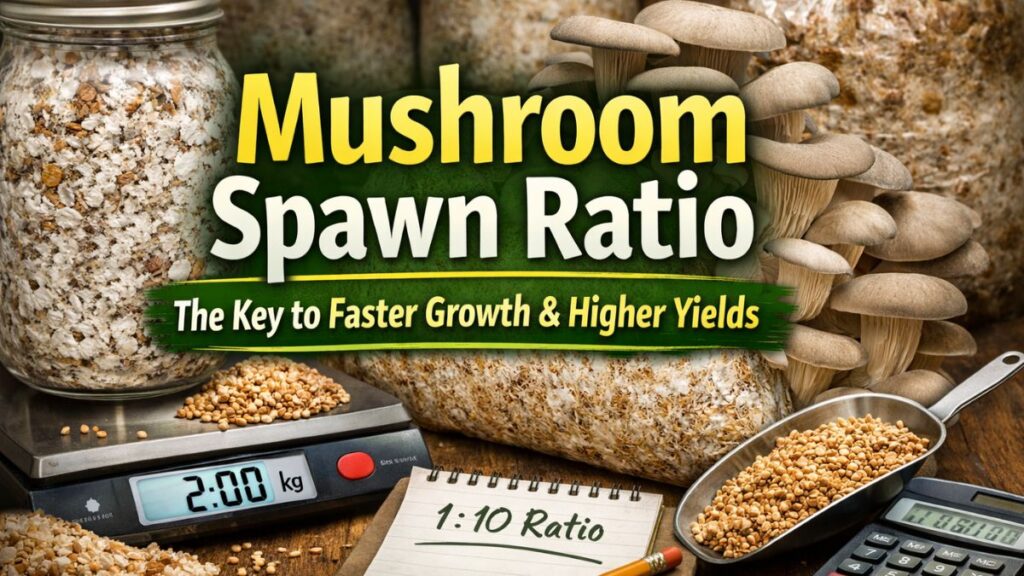
The ratio simply compares the two. A 1:5 ratio means one part spawn to five parts substrate. Many growers quote a percentage instead, based on substrate weight. By that measure, 1:10 is about 10%, and 1:5 is about 20%.
Why it becomes a race
Think of fresh substrate as an open buffet. Your mushroom mycelium wants it, but so do mold and bacteria, and they are always looking for a way in.
More spawn means more starting points. The mycelium spreads from many places at once and claims the food before anything else can. Fewer starting points mean a slower start and a longer window for trouble. That is the whole logic behind getting your ratio right.
How Mushroom Spawn Ratio Affects Growth Speed and Yield
What happens with too little spawn
It usually shows up in a few familiar ways:
- Colonization crawls along, sometimes taking weeks longer than expected
- Growth looks patchy, with white zones sitting next to bare spots
- Contamination risk climbs because the substrate stays unprotected for longer
- Pins form unevenly, so harvests are smaller and harder to time
If you have ever thrown away a bag that “just never took off,” a low spawn dose may have been part of the story.
What happens with too much spawn
More is not automatically better. Spawn is often the most expensive part of a grow, and the returns shrink as you add it. Past a certain point, you are paying for speed you no longer gain.
Grain is also nutritious for competitors, not just for your mushrooms. A heavy dose of damp grain can feed bacteria if conditions slip. And in a fixed-size bag, extra spawn takes the place of substrate, the food your mushrooms need for later flushes.
Finding the sweet spot
Most hobby growers land somewhere between 1:5 and 1:10 for pasteurized straw and sawdust. Use the 1:5 end when your setup is less than sterile or your substrate is vulnerable. Lean toward 1:10 when your technique is clean and you want to stretch your spawn further.
What Shifts the Ideal Ratio
There is no single magic number, because every grow is a little different. Three things matter most.
Substrate and preparation
Sterilized substrate has almost no living competitors, so it can get away with less spawn. Pasteurized substrate, like most straw, still carries some microbes. It needs a bigger head start from your mycelium, so a higher spawn dose is the safer choice.
Spawn quality and age
A ratio assumes healthy spawn. Fresh, vigorous, fully colonized spawn can do the job at 1:10. Old, dried-out or half-colonized spawn may fail even at 1:5. When you buy spawn, check the date and look for firm, evenly white growth with no off smells.
Temperature and strain
Some species and strains grow faster than others. Cooler rooms slow everything down, giving contaminants more time to compete. If your space runs cool, a slightly higher spawn dose helps make up the difference.
Recommended Ratios by Mushroom and Substrate
Treat these as starting points, not laws. Strain, moisture and temperature all play a part, so also check your spawn supplier’s guidance.
Spawn ratio for oyster mushrooms on straw
Oysters are fast and forgiving, which makes them ideal for beginners.
- Typical range: 1:5 to 1:10, roughly 10–20% of wet straw weight
- Beginners: stay near 1:5 for quicker, safer colonization
- Experienced growers: 1:10 can work well with clean pasteurization
Shiitake and lion’s mane on sawdust
These wood lovers colonize more slowly than oysters, so a generous dose of spawn helps protect the block.
- Typical range: about 1:5 to 1:10 on hardwood sawdust
- Supplemented blocks: extra nutrients attract contaminants too, so many growers stay toward the higher spawn amount
Grain-to-grain transfers
Expanding your own spawn works the same way. One colonized jar or bag into five to ten fresh, sterilized ones is a common range. A tighter ratio finishes faster, while stretching it further means more waiting and a little more risk.
How to Calculate Your Spawn Ratio Step by Step
Weigh instead of eyeballing
Weigh your hydrated substrate, not the dry material. Volume can work if you stay consistent, but weight is far more repeatable from batch to batch. A basic kitchen scale is all you need.
A worked example
Wondering how much spawn to use per kg of substrate? Here is the quick method:
- Weigh your wet, pasteurized substrate.
- Pick your ratio, for example 1:8.
- Divide the substrate weight by the second number.
Example one: 10 kg of wet straw at 1:8 needs 1.25 kg of spawn. At 1:5 it needs 2 kg, and at 1:10 it needs 1 kg.
Example two: for the ideal spawn rate for mushroom grow bags, take a 2 kg sawdust block. At 10–20%, that means 200–400 g of spawn per bag.
Notice how a small change in ratio adds up fast when you scale to dozens of bags. A grain spawn to substrate ratio of 1:5 instead of 1:10 doubles your spawn bill.
Let a calculator do the math
When you are scaling up or growing several species at once, doing sums by hand gets old quickly. The Mushroom Spawn Ratio Calculator helps you work out how much spawn each batch needs, so you can plan your purchases and skip the mental math.
Mixing Spawn for Even Colonization
The right ratio only works if the spawn is spread evenly through the substrate.
Distribute it well
- Break up clumps gently with clean hands
- Fold the spawn through the substrate, or add it in layers
- Do not pack the bag tight, because mycelium needs air
- Seal and label each bag straight away
Keep it clean
- Wash your hands and wipe surfaces with sanitizer or isopropyl alcohol
- Let hot substrate cool fully before mixing, since heat can kill mycelium
- Work steadily and keep bags open for as short a time as possible
Mistakes That Quietly Cost You Yield
Common slip-ups
- Eyeballing amounts: “a good handful” is different every time
- Using old or weak spawn: the ratio assumes healthy mycelium
- Ignoring moisture: substrate that is too wet or too dry will undo a perfect ratio
- Changing everything at once: you will never know what worked
- Assuming more is always better: it often just costs more
A simple test you can run this month
Want to find your own best number? Run three bags with the same substrate, spawn and conditions, at 1:5, 1:8 and 1:10. Label them and write down two things: days to full colonization, and the weight of the first flush.
Within one cycle, you will know which ratio suits your space, strain and budget. That result is worth more than any general guide, including this one.
FAQs
What is the best mushroom spawn ratio for beginners?
Most beginners do well with 1:5 to 1:8. The extra spawn gives your mycelium a strong head start, which makes up for small mistakes in cleanliness or temperature.
Can I use less spawn to save money?
Yes, but there is a trade-off. Lower ratios colonize more slowly and carry more contamination risk. Cut back gradually, and only once your process is clean and consistent.
Should I measure spawn ratio by weight or volume?
Weight is more accurate because substrates vary in how loosely they pack. If you prefer volume, use the same containers every time so your results stay comparable.
How do I know my ratio is working?
You should see white mycelium growth within a few days, spreading steadily through the whole bag. Warning signs include green or black patches, sour smells and large bare zones.
Conclusion
Your spawn ratio is one of the few things you fully control, and it costs nothing to get right. Start with 1:5 to 1:10 for your mushroom and substrate, weigh everything, and keep notes.
Then run the three-bag test and let your own results guide you. When you are ready to plan your next batch, try the Mushroom Spawn Ratio Calculator and see exactly how much spawn you need. Your next flush could be faster, cleaner and bigger.