You mixed a clean substrate, added healthy spawn, and kept the temperature steady. Yet the mycelium crawls along at half speed, or a patch of green mold shows up overnight. Before you blame the spawn, check something most beginners never measure: pH.
This Mushroom pH Level Guide explains why pH shapes every stage of your grow and how to test and correct it without a chemistry degree. You’ll get target ranges for popular species, a simple six-step routine, and the mistakes worth avoiding.
What pH Really Means for Your Mushrooms
pH in Plain English
pH measures how acidic or alkaline something is on a scale from 0 to 14. Seven is neutral, like pure water. Lower numbers are more acidic, like vinegar. Higher numbers are more alkaline, like baking soda.
Most mushroom substrates sit between 4.5 and 8, depending on what you feed them. Hardwood sawdust leans acidic. Straw and compost sit closer to neutral or slightly alkaline.
Why Mycelium Cares
Mycelium is the root-like network that eventually produces mushrooms. It absorbs nutrients through its surface, and pH affects which nutrients are available and how well its digestive enzymes work.
In the right range, colonization is quick and the network turns thick and white. Outside it, growth slows, and a slow colony is an easy target for anything faster.
Why Contaminants Care Too
Many bacteria thrive in neutral to slightly alkaline conditions, and some molds tolerate almost anything. A substrate that suits your mushroom better than the competition gives your culture a head start.
pH won’t replace good sterilization and clean technique. It quietly tilts the odds in your favor.
The Best pH for Growing Mushrooms
There’s no single magic number. Each species evolved on a different food source, so each has its own comfort zone. These are common starting points for substrate pH at inoculation.
Ideal pH for Oyster Mushrooms and Other Popular Species
- Oyster mushrooms: roughly 6.0–7.0. Famously forgiving, which is why beginners love them.
- Lion’s mane: roughly 5.5–6.5.
- Shiitake: roughly 5.0–6.0. They prefer more acidic conditions, like the oak logs they grow on.
- Reishi: roughly 5.0–6.0.
- White button mushrooms: roughly 6.5–7.5 for compost.
Why Ranges Beat Exact Targets
Substrates drift. As mycelium feeds, it releases acids and changes its own environment, so a reading of 6.3 today could be closer to 5.8 next week.
Aim for the middle of your species’ range at the start, and don’t chase decimals. Sources vary slightly, so treat these numbers as guides and follow your spawn supplier’s advice when they give any.
What You Need Before You Start Testing
Choosing the Right pH Tool
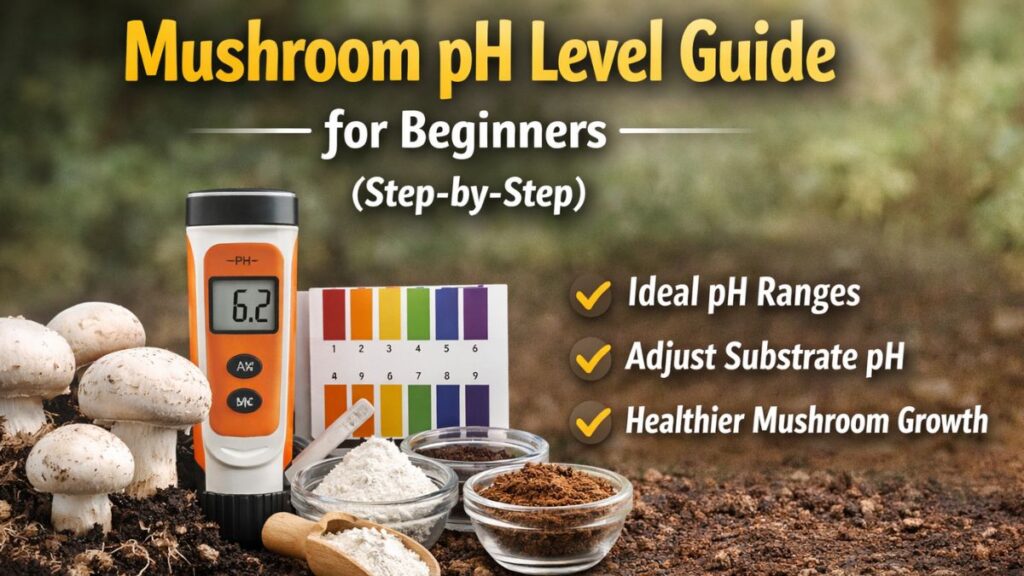
- Digital pH meter: the most accurate and easiest to read. A pen-style meter with a replaceable probe is a solid beginner pick.
- Liquid test kits: a middle ground, though colors can be hard to judge.
- Test strips: cheap and quick for a rough idea, but murky, tea-colored slurry makes them tough to read.
If you’ll test regularly, a meter pays for itself in avoided failed batches.
Gather Your Supplies
- Distilled water
- A clean jar or cup and a spoon you can sanitize
- pH 4.0 and 7.0 calibration solutions (for meters)
- A notebook or phone notes for logging results
- Gloves, if you’ll be adjusting with lime
A Simple Mushroom pH Level Guide: 6 Steps From Test to Fix
Here’s a routine you can finish in about 20 minutes.
How to Test Mushroom Substrate pH (Steps 1–3)
Step 1: Calibrate your meter. Dip the probe in the pH 7.0 solution, then pH 4.0, following your meter’s instructions. Rinse with distilled water between each.
Step 2: Make a slurry. Mix your finished substrate (with all supplements added) and distilled water in roughly equal parts by volume. Stir well and let it rest 10–15 minutes. Skip tap water. Its own minerals and pH can skew the result.
Step 3: Take the reading. Dip the probe, wait for the number to settle, and write it down. Test two or three spots and average them, because a single sample can mislead you.
Tip: Heat can nudge pH slightly. If a batch behaves oddly, test a sample after sterilizing too.
How to Adjust Mushroom Substrate pH (Steps 4–6)
Step 4: Compare your number to your species’ range. Within range? You’re done. Slightly off? A small tweak is enough.
Step 5: Adjust a little at a time. The next section covers what to use.
Step 6: Mix, wait, retest, and log it. Record the recipe, the pH, and how the batch performed. After a few grows, patterns jump out.
Adjusting pH Safely: What Works and What to Avoid
Raising pH (When Substrate Is Too Acidic)
- Hydrated lime raises pH quickly, so use tiny amounts, mix thoroughly, and retest. Wear gloves and a dust mask, since it irritates skin and lungs.
- Ground limestone (calcium carbonate) is gentler and slower, which makes it easier to control.
- Gypsum is popular for calcium and better substrate structure, but it barely shifts pH. Don’t count on it as a fix.
Lowering pH (When Substrate Is Too Alkaline)
- Increase the share of naturally acidic ingredients, such as hardwood sawdust, or cut back on the alkaline additive you used.
- For small tweaks, a few drops of diluted food-grade citric acid or white vinegar in your mixing water can work. Go slowly and retest.
Go Slow and Change One Thing at a Time
Over-correcting is far easier than under-correcting. Adjust in small steps and change one variable per batch, so you know exactly what worked.
One note on straw: some growers soak it in high-pH lime water (around pH 12) to pasteurize it. That spike is deliberate and temporary. Drain the straw well and check it before inoculating, because that number is not your target.
Common pH Mistakes Beginners Make
Five Mistakes to Skip
- Using tap water for the slurry
- Skipping calibration, since a drifting meter gives confident but wrong numbers
- Testing one spot and trusting it
- Dumping in lime or acid to fix everything in one go
- Blaming pH for everything, when moisture, temperature, and sterile technique matter just as much
Signs Your pH Might Be Off
- Mycelium is slow even though temperature and moisture look right
- Growth is thin, patchy, or wispy
- Wet, sour-smelling contamination keeps appearing
- Identical recipes give very different results
These signs have many causes. Treat them as a reason to test, not as a diagnosis.
Skip the Guesswork With a pH Calculator
Doing this by hand works, but it’s easy to lose track of ranges once you grow more than one species. Our Mushroom pH Level Calculator helps you check your reading against the range for your mushroom and plan your next adjustment. That means less second-guessing and more growing. Run your next batch through it before you inoculate.
FAQs
What is the best pH for growing mushrooms?
Most popular gourmet species do well with substrate between about 5.0 and 7.0. Oysters sit at the higher end and shiitake at the lower end, so check the range for your species.
Do I need to test pH on every batch?
Not always. A proven recipe made with consistent ingredients is usually reliable. Test when you try a new recipe, switch ingredients, or notice unexplained slow growth.
Does pH change during the grow?
Yes. Mycelium releases acids as it feeds, so pH usually drifts over time. That’s why the starting range matters more than a perfect number.
Are cheap test strips good enough?
They’re fine for a rough check, but a digital meter is more reliable. Slurry color can make strips hard to read.
Conclusion
You don’t need a lab to get pH right. Know your species’ range, test with a calibrated meter and distilled water, adjust in small steps, and write everything down.
Start with your next batch. Take one reading, log it, and compare it with how the mycelium performs. Within a few grows you’ll know what your substrate needs. When you’re ready, use the Mushroom pH Level Calculator to make it faster.