Ever wondered why some mushroom growers harvest fresh crops every single week while others struggle with inconsistent yields? The secret isn’t luck—it’s a well-planned Weekly Mushroom Production Schedule.
When you follow a structured routine, you create a continuous growing cycle that ensures steady production, minimizes downtime, and maximizes profits. Whether you’re a beginner or scaling your farm, mastering this schedule can completely transform your results.
Let’s break it down step by step so you can grow smarter—not harder.
Understanding the Weekly Mushroom Production Cycle
Why a Weekly Schedule Matters
A consistent workflow keeps your production flowing without interruptions. Instead of waiting weeks for a single harvest, you stagger tasks to ensure ongoing output.
Key benefits:
- Continuous weekly harvests
- Better time and resource management
- Reduced contamination risks
- Higher overall yield
The Core Stages of Production
Every successful Weekly Mushroom Production Schedule follows these essential stages:
- Substrate Preparation – Preparing nutrient-rich growing material
- Inoculation – Adding mushroom spawn
- Colonization – Mycelium spreads through the substrate
- Fruiting – Mushrooms begin to grow
- Harvesting – Collecting mature mushrooms
By assigning each stage to specific days, you create a smooth, repeatable system.
Step-by-Step Weekly Mushroom Production Schedule
Day-by-Day Workflow Plan
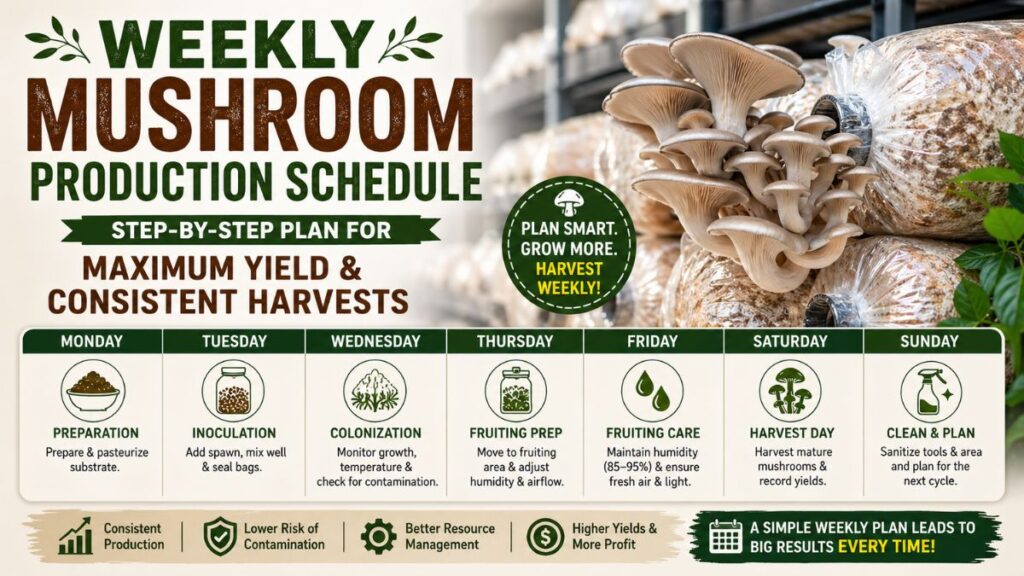
Here’s a simple and effective weekly routine you can follow:
- Monday – Preparation Day
- Gather materials
- Prepare and pasteurize substrate
- Tuesday – Inoculation Day
- Add spawn to substrate
- Seal and label bags
- Wednesday – Colonization Monitoring
- Check temperature and humidity
- Inspect for contamination
- Thursday – Fruiting Preparation
- Move fully colonized bags to fruiting area
- Adjust humidity and airflow
- Friday – Fruiting Management
- Maintain 85–95% humidity
- Ensure proper light and fresh air
- Saturday – Harvest Day
- Pick mature mushrooms
- Record yields
- Sunday – Cleaning & Maintenance
- Sanitize workspace
- Prepare for next cycle
Tools to Simplify Your Schedule
Planning manually can get overwhelming. That’s why using tools like the Mushroom Production Schedule Calculator, can help you automate your workflow, optimize timing, and avoid costly mistakes.
How This Improves Yield
A structured plan ensures:
- No idle time between batches
- Better environmental control
- Faster turnaround cycles
This is especially helpful for those searching for a step-by-step mushroom farming schedule for beginners.
Expert Tips, Mistakes to Avoid & Best Practices
Pro Tips for Maximum Output
To get the most from your Weekly Mushroom Production Schedule, follow these expert tips:
- Maintain consistent temperature (20–25°C for most varieties)
- Use high-quality spawn for faster colonization
- Ensure proper air exchange during fruiting
- Track every batch for performance improvement
These practices align perfectly with a mushroom cultivation weekly workflow for high yield.
Common Mistakes to Avoid
Many growers unknowingly reduce their yield due to simple errors:
- ❌ Skipping sterilization steps
- ❌ Overwatering or low humidity control
- ❌ Poor ventilation
- ❌ Mixing old and new batches
Avoiding these ensures your how to schedule mushroom production weekly strategy stays effective.
Safety & Hygiene Practices
Cleanliness is critical in mushroom farming:
- Always disinfect tools and surfaces
- Wear gloves during inoculation
- Keep growing areas separate
- Dispose of contaminated bags immediately
This is crucial for maintaining a reliable continuous mushroom harvest planning guide.
FAQs:
1. How long does a weekly mushroom cycle take?
A full cycle typically takes 3–5 weeks, but a staggered schedule ensures weekly harvests.
2. Can beginners follow a Weekly Mushroom Production Schedule?
Yes! It’s one of the easiest ways to stay organized and improve results from the start.
3. What is the biggest factor affecting yield?
Environmental control—especially humidity, temperature, and airflow—plays the biggest role.
Conclusion:
A well-structured Weekly Mushroom Production Schedule is the foundation of consistent success in mushroom farming. It transforms chaos into clarity, helping you produce more with less effort.